
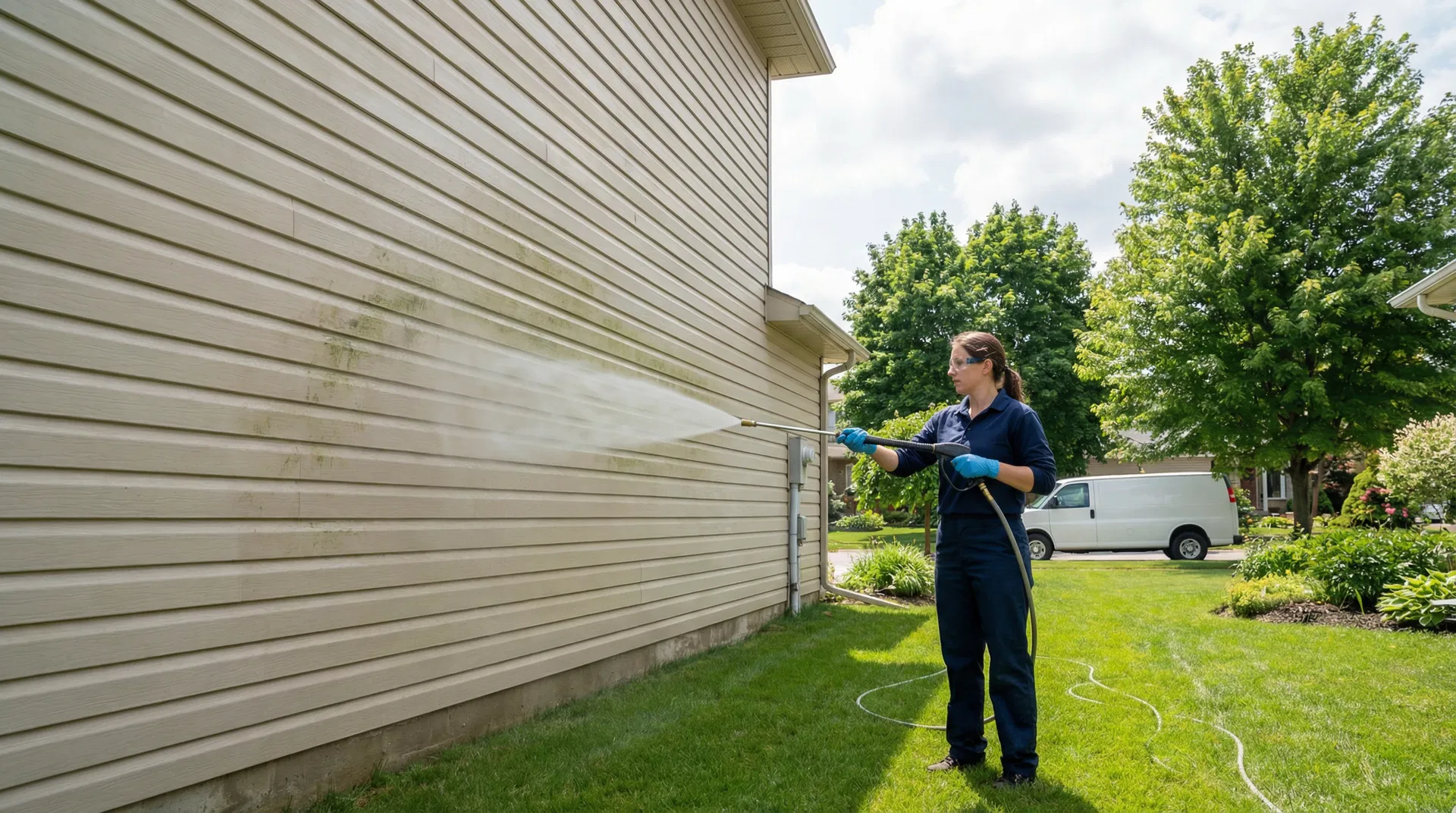
Most Ontario homeowners think about washing their house exterior once — maybe when they're putting it up for sale, or when the siding looks visibly green. But waiting until the problem is obvious means the dirt, algae, and oxidation have already been doing damage for months. Ontario's climate is particularly hard on home exteriors, and a regular cleaning schedule protects your investment and keeps your home looking its best year-round.
Why Ontario's Climate Makes Regular Exterior Cleaning Essential
Homeowners in drier climates like British Columbia's interior or the prairies can often get away with washing their home exterior every two to three years. In Ontario — especially in the Hamilton, Burlington, and Dundas area — the conditions are significantly more demanding:
- Freeze-thaw cycles — repeated freezing and thawing through November to March forces moisture into micro-cracks in siding, caulking, and painted surfaces. Dirt and organic matter trapped in those cracks accelerates the damage.
- Humid summers — Hamilton sits in the Great Lakes basin, and summer humidity regularly exceeds 80%. This creates ideal conditions for algae, mould, and mildew to establish on north-facing walls, under eaves, and in shaded corners.
- Heavy pollen seasons — spring pollen from the Dundas Valley's mature tree canopy coats every surface in a fine yellow-green film. Left unwashed, pollen bonds with surface moisture and becomes a food source for biological growth.
- Road salt splash — homes near roads in Hamilton, Stoney Creek, and Burlington accumulate salt residue on lower siding and foundations through the winter months. Salt accelerates oxidation on metal trim and stains concrete and brick.
The General Rule: Once a Year, Minimum
For most Ontario homes, a professional exterior wash once per year is the baseline. The ideal timing is late spring — after the last frost has passed and pollen season is winding down, but before the heat of summer allows algae to establish. This timing removes the winter's accumulation of salt, grime, and pollen before it has a chance to bond permanently to your siding.
Some homes benefit from a second wash in early fall, particularly those with heavy tree cover, homes near busy roads, or properties with north-facing walls that stay shaded and damp. A fall wash removes the summer's biological growth before it goes dormant for winter — dormant algae and moss are harder to remove in spring than fresh growth.
Surface-by-Surface Cleaning Frequency Guide
Different surfaces on your home's exterior accumulate dirt and biological growth at different rates, and they require different cleaning methods. Here is a practical guide for Ontario homeowners:
| Surface | Recommended Frequency | Method |
|---|---|---|
| Vinyl siding | Once per year | Soft wash |
| Brick or stone | Every 1–2 years | Low-pressure wash |
| Wood siding / painted wood | Once per year | Soft wash (gentle) |
| Concrete driveway | Once per year | Pressure wash |
| Interlock / paving stone | Once per year | Pressure wash |
| Deck or fence (wood) | Once per year | Low-pressure wash |
| Eavestroughs (exterior face) | Once per year | Hand wash or low-pressure |
| Fascia and soffits | Once per year | Soft wash |
Vinyl Siding: The Most Common Exterior in Hamilton
Vinyl siding is the most popular exterior cladding in Hamilton-area homes built since the 1980s, and it requires soft washing — not pressure washing. High-pressure water can crack vinyl panels, force water behind the siding into the wall cavity, and strip the UV-protective coating that prevents fading. Soft washing uses a low-pressure rinse combined with a biodegradable cleaning solution that safely removes algae, mildew, and oxidation without damaging the panels.
Vinyl siding that is not cleaned annually tends to develop a chalky, oxidized appearance that becomes progressively harder to reverse. Algae and mildew staining on vinyl, if left for two or more years, can permanently discolour the surface. Annual cleaning is genuinely preventive maintenance, not just cosmetic.
Brick and Stone: Less Frequent, But Still Important
Brick and natural stone are more durable than vinyl, but they are also more porous — which means they absorb and hold biological growth more deeply. Hamilton's older brick homes in neighbourhoods like Durand, Corktown, and Westdale often develop significant efflorescence (white salt deposits) and biological staining on the mortar joints. A professional low-pressure wash every one to two years removes this buildup before it penetrates deep into the masonry.
Brick should never be cleaned with high-pressure washing, which can erode mortar joints and damage the brick face. Low-pressure washing with appropriate cleaning solutions is the correct method.
Driveways and Interlock: Annual Pressure Washing
Concrete driveways and interlock paving stones are the one area where pressure washing is not only appropriate but recommended. Concrete is dense enough to withstand high-pressure cleaning, and the combination of road salt, tire marks, oil stains, and biological growth that accumulates over an Ontario winter requires the mechanical force of pressure washing to remove effectively.
For interlock specifically, annual cleaning also removes the moss and weeds that establish in the joints, which if left unchecked will eventually displace the stones and require costly re-levelling. After pressure washing interlock, the joints should be re-sanded with polymeric sand to prevent weed re-establishment.
Signs Your Home Exterior Needs Cleaning Now
Even if you're not on a regular schedule yet, these are the signs that your home needs professional exterior cleaning as soon as possible:
- Green, black, or brown streaking on siding, particularly on north-facing walls
- A chalky or dull appearance on vinyl siding that doesn't improve with rain
- White efflorescence (salt deposits) on brick or concrete
- Dark staining on the lower courses of siding near the foundation
- Visible moss or lichen growth on any surface
- Oil or rust stains on the driveway
- Eavestroughs that appear dark or stained on the exterior face
The Cost of Waiting
The financial case for regular exterior cleaning is straightforward. Algae and mildew that are cleaned annually cost a fraction of what they cost to remediate after two or three years of unchecked growth. Vinyl siding that is replaced because of permanent staining or oxidation costs $8,000–$20,000 for a typical Hamilton home. A professional soft wash costs a small fraction of that, and done annually, it prevents the damage from ever reaching that point.
Beyond the financial argument, a clean home exterior maintains curb appeal and property value — particularly relevant in Hamilton's competitive real estate market, where first impressions matter.
Professional vs. DIY Exterior Washing
Many homeowners attempt to wash their own siding with a garden hose or a rented pressure washer. The results are often disappointing — garden hoses lack the pressure and cleaning chemistry to remove biological growth, and rented pressure washers in the hands of inexperienced operators frequently damage siding, windows, and caulking. Professional exterior cleaning uses the correct pressure, the correct cleaning solutions for each surface type, and the experience to identify and avoid vulnerable areas like window seals, electrical fixtures, and painted trim.
BTG Exteriors provides professional house washing, soft washing, and pressure washing services throughout Hamilton, Dundas, Burlington, Oakville, Stoney Creek, Ancaster, and Grimsby. Every job uses biodegradable, eco-friendly cleaning solutions that are safe for your family, pets, and garden. Contact us for a free, no-obligation quote.
Ready to Schedule Your Annual Exterior Wash?
BTG Exteriors serves Hamilton, Dundas, Burlington, Oakville, and surrounding communities. Free quotes, typically within 2 hours.